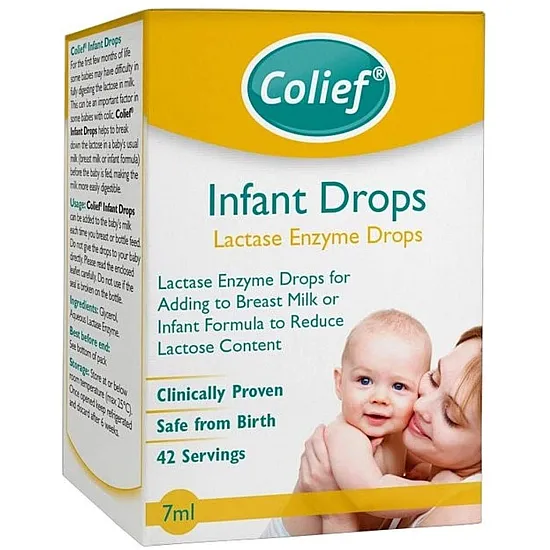
Original: $9.49
-65%$9.49
$3.32The Story
What Are Lactase Enzyme Drops for Babies?
If your baby cries inconsolably after feeds, draws their knees up, or seems in real discomfort, colic can feel overwhelming — for both of you. Lactase enzyme drops for babies like Colief Infant Drops offer a targeted approach to one of the most common underlying causes: temporary lactose intolerance. Lactose is the natural sugar found in breast milk and most infant formulas, and some babies simply don't produce enough of the enzyme lactase to digest it fully. The result? Undigested lactose ferments in the gut, producing gas and discomfort. Colief works by supplementing that missing enzyme directly in the feed, before your baby even takes their first sip. You can browse our full range of baby and toddler products for more options to support your little one's health.
Colic affects an estimated one in five babies in the UK, typically starting around two to three weeks of age and often resolving by three to four months. It's distressing, but it's also very common — and you're not alone in looking for answers.
How Do Colief Infant Drops Work?
Colief contains lactase, a naturally occurring digestive enzyme. When added to breast milk or formula before a feed, it begins breaking down lactose into simpler sugars — glucose and galactose — that are far easier for your baby's immature gut to absorb. The mechanism is straightforward:
- Lactase enzyme is added to a small amount of expressed breast milk or prepared formula.
- The enzyme begins hydrolysing (breaking down) lactose molecules within the milk.
- After the recommended standing time, the feed contains significantly less intact lactose.
- Your baby digests the feed more comfortably, with less gas and fermentation in the gut.
- Over time, as the gut matures, the need for supplemental lactase typically reduces.
It's worth noting that Colief doesn't treat an allergy to cow's milk protein — that's a separate condition. If your baby has a confirmed cow's milk protein allergy (CMPA), speak to your GP, as a different approach will be needed.
Who Should Use Colief Infant Drops?
Colief is designed for infants from birth onwards who show signs of colic that may be linked to temporary lactose intolerance. It's suitable for use with both breastfed and formula-fed babies. That said, it's always worth speaking to your health visitor or GP before starting any new product, particularly if your baby's symptoms are severe or you're unsure of the cause.
- Infants from birth experiencing colic symptoms after feeds.
- Breastfed babies whose mothers wish to continue breastfeeding.
- Formula-fed babies on standard lactose-containing formula.
- Babies where other colic remedies have not provided sufficient relief.
Colief is not suitable for infants with galactosaemia, a rare inherited metabolic disorder in which the body cannot process galactose. If you're unsure whether this applies to your baby, consult your GP before use.
How Does Colief Compare to Other Colic Remedies?
| Feature | Colief Infant Drops | Simethicone Drops (e.g. Infacol) |
|---|---|---|
| Active ingredient | Lactase enzyme | Simethicone |
| Mechanism | Breaks down lactose before feeding | Reduces surface tension of gas bubbles |
| Suitable from birth | Yes | Yes |
| Addresses lactose digestion | Yes | No |
| Added to feed before use | Yes | No — given directly to baby |
How Should You Store Colief Infant Drops?
Once opened, Colief Infant Drops must be stored in the refrigerator between 2°C and 8°C and used within 30 days. Before opening, the drops can be stored below 25°C. Always keep the bottle tightly closed and out of the reach of children. Do not use after the expiry date printed on the label.
If you're managing other aspects of your baby's or family's health, you might also find our vitamins and supplements collection useful for supporting overall wellbeing alongside targeted treatments like Colief.
This product is a medicine. Speak to your doctor or pharmacist before using if you have an underlying medical condition or are taking other medicines.
Colief Lactase Enzyme Infant Drops 7ml specifications
| Treatment category | Infant colic / digestive support |
| Mechanism of action | Enzymatic hydrolysis of lactose in breast milk or formula |
| Effective for | Colic symptoms associated with temporary lactose intolerance in infants |
| Suitable for | Infants from birth (not suitable for infants with galactosaemia) |
| Active ingredient | Lactase enzyme (50 ALU per drop) |
| Pack size | 7ml |
| UK classification | General Sale List (GSL) |
| Drug class | Digestive enzyme supplement |
| Preparation | Oral drops (liquid) |
| Route of administration | Oral (added to feed) |
Specifications of Colief Lactase Enzyme Infant Drops 7ml
What Is Colief and What Is It Used For?
Colief Lactase Enzyme Infant Drops is an oral liquid preparation containing lactase enzyme. It is used to help manage colic symptoms in infants that are thought to be caused by temporary lactose intolerance. Lactose intolerance in babies is usually temporary — the infant gut is still developing, and lactase production may be insufficient in the early weeks and months of life. By adding Colief to breast milk or formula before a feed, you reduce the lactose load your baby's gut has to handle, which can significantly ease symptoms such as prolonged crying, wind, and abdominal discomfort.
Colief is classified as a General Sale List (GSL) medicine in the UK, meaning it is available without a prescription. It is not a treatment for cow's milk protein allergy (CMPA), and if your baby's symptoms persist or worsen, you should seek advice from your GP or health visitor.
What Do You Need to Know Before Using Colief?
Before using Colief, read the following carefully. There are specific situations where this product should not be used or where caution is needed.
Do not use Colief if your baby:
- Has been diagnosed with galactosaemia — a rare inherited condition where the body cannot metabolise galactose.
- Has a known hypersensitivity to any of the ingredients in the product.
- Has been diagnosed with cow's milk protein allergy (CMPA) — Colief does not address this condition.
Warnings and precautions:
- Always consult your GP or health visitor if you are unsure whether your baby's colic is related to lactose intolerance.
- Do not add Colief to feeds that are above body temperature, as excessive heat may reduce enzyme activity.
- If symptoms do not improve within one week of use, seek medical advice.
- Keep out of the reach and sight of children.
Known drug interactions:
- No clinically significant drug interactions with Colief Infant Drops are currently known.
- If your baby is taking any prescribed medicines, speak to your pharmacist or GP before use as a precaution.
How Should You Use Colief Infant Drops?
Using Colief correctly is important to get the most benefit. The drops must be added to the feed — not given directly to the baby on their own. Follow these steps carefully:
- Wash your hands thoroughly before handling the drops or preparing a feed.
- For breastfeeding: Express a small amount of breast milk (approximately 1 teaspoon / 5ml) into a sterilised container.
- Add 4 drops of Colief to the expressed milk and mix gently.
- Feed this mixture to your baby using a sterilised spoon or dropper before putting them to the breast.
- For formula feeding: Prepare the formula feed as directed on the packaging.
- Allow the formula to cool to body temperature (approximately 37°C), then add 4 drops of Colief.
- Leave the prepared feed to stand for at least 30 minutes in the refrigerator before use, to allow the enzyme to work.
- Warm the feed gently before giving to your baby — do not microwave, as this can create hot spots and may reduce enzyme activity.
| Feeding Method | Age Group | Dose | Frequency |
|---|---|---|---|
| Breastfeeding | From birth | 4 drops per feed | With every feed |
| Formula feeding | From birth | 4 drops per feed | With every feed |
If you're also managing digestive discomfort in older family members, our IBS and cramps collection has a range of products that may help.
What Are the Possible Side Effects of Colief?
Colief is generally considered well tolerated in infants. However, as with any product, some babies may experience mild reactions. If you notice anything that concerns you, stop use and speak to your pharmacist or GP.
Common side effects (may affect a small number of users):
- Mild changes in stool consistency or frequency — this is usually temporary.
- Slightly looser stools, which may occur as the gut adjusts to improved lactose digestion.
Less common side effects (rare):
- Skin reactions such as rash — stop use immediately and seek medical advice if this occurs.
- Unusual irritability or feeding refusal — while not directly attributed to Colief, always consult your GP if your baby's behaviour changes significantly.
There are no known serious adverse effects associated with Colief when used as directed. If your baby shows signs of an allergic reaction — such as swelling, difficulty breathing, or severe rash — seek emergency medical attention immediately.
How Should You Store Colief Infant Drops?
- Before opening: Store below 25°C in a cool, dry place away from direct sunlight.
- After opening: Refrigerate between 2°C and 8°C.
- Use within 30 days of opening — discard any remaining product after this time.
- Do not freeze.
- Keep the bottle tightly closed when not in use.
- Do not use after the expiry date printed on the label.
- Keep out of the reach and sight of children at all times.
For other products to support your family's health and comfort, explore our sickness and nausea range, which includes options for managing digestive upset across different age groups.
References
- https://www.nhs.uk/conditions/colic/
- https://www.nhs.uk/conditions/lactose-intolerance/
- https://www.nhs.uk/conditions/baby/breastfeeding-and-bottle-feeding/breastfeeding/breastfeeding-problems/
- https://www.nhs.uk/conditions/cows-milk-allergy-in-children/
- https://www.nhs.uk/conditions/baby/caring-for-a-newborn/soothing-a-crying-baby/
- https://www.medicines.org.uk/emc/product/1026/smpc
Written and reviewed by our qualified team
Your safety and success are our highest priorities. Our medical team rigorously evaluates every product and piece of advice we provide, ensuring you receive only the most effective, science-backed solutions available.
Frequently Asked Questions
Where can I buy Colief Infant Drops online in the UK?
You can buy Colief Lactase Enzyme Infant Drops 7ml directly from Cured Pharmacy for £9.49, with no prescription required. It is a General Sale List (GSL) medicine available over the counter. Browse our full baby and toddler range for more products to support your infant's health.
How do Colief Infant Drops work in the body?
Colief contains lactase enzyme, which breaks down lactose — the natural sugar in breast milk and formula — into simpler sugars that are easier for your baby's immature gut to absorb. This reduces the amount of undigested lactose fermenting in the intestine, which is thought to be a key driver of colic-related discomfort. The enzyme works directly in the feed before your baby drinks it, not inside the baby's stomach.
How do I use Colief Infant Drops step by step?
For breastfeeding, express a small amount of milk, add 4 drops of Colief, and offer this to your baby before putting them to the breast. For formula, prepare the feed, cool it to body temperature, add 4 drops, and refrigerate for at least 30 minutes before warming and feeding. Always use a sterilised container and follow the instructions in the product leaflet carefully.
What is the correct dose of Colief Infant Drops for my baby?
The recommended dose is 4 drops per feed, used with every feed throughout the day. This applies to both breastfed and formula-fed infants from birth. Do not exceed this dose without guidance from a healthcare professional such as your GP or pharmacist.
When is the best time to use Colief Infant Drops?
Colief should be added to every feed, not just some of them, to maintain consistent reduction of lactose in your baby's diet. For formula-fed babies, it works best when added at least 30 minutes before the feed is given, so plan ahead and prepare feeds in advance where possible. Consistency is key — using it with every feed gives the best chance of reducing colic symptoms.
Are there any side effects of Colief Infant Drops?
Colief is generally well tolerated, but some infants may experience mild changes in stool consistency or slightly looser stools as the gut adjusts. Serious side effects are rare, but if your baby develops a rash, unusual irritability, or any signs of an allergic reaction, stop use immediately and contact your GP. Always report any unexpected changes in your baby's health to a healthcare professional.
How do I manage side effects of Colief Infant Drops?
If your baby experiences loose stools, this often settles within a few days as their digestive system adjusts — continue use and monitor closely. For any skin reactions or worsening symptoms, discontinue use and seek advice from your pharmacist or GP promptly. Do not attempt to adjust the dose yourself without professional guidance.
Who is eligible to use Colief Infant Drops?
Colief is suitable for infants from birth who experience colic symptoms that may be linked to temporary lactose intolerance, whether they are breastfed or formula-fed. It is not suitable for babies with galactosaemia or a confirmed cow's milk protein allergy (CMPA). If you are unsure whether Colief is appropriate for your baby, speak to your health visitor or GP before starting.
What happens if I forget to add Colief to a feed?
If you miss adding Colief to one feed, simply continue as normal with the next feed and add the drops then — do not double the dose to compensate. Missing an occasional feed is unlikely to cause harm, but consistent use with every feed gives the best results. Try to build it into your feeding routine to make it easier to remember.
Can I use Colief Infant Drops with any type of formula?
Colief can be used with standard lactose-containing infant formulas. It is not intended for use with lactose-free formulas, as there is no lactose present for the enzyme to break down. If your baby is already on a lactose-free or hypoallergenic formula prescribed by a doctor, speak to your GP before adding Colief.
What are alternatives to Colief Infant Drops for colic?
Common alternatives include simethicone-based drops such as Infacol, which work by reducing gas bubble surface tension rather than addressing lactose digestion, and gripe water, which contains herbal ingredients. Unlike lactase enzyme drops for babies, these alternatives do not target the root cause of lactose-related colic. Your pharmacist or health visitor can help you decide which option is most appropriate for your baby's specific symptoms.
How long do you use Colief Infant Drops for?
Colief is typically used until the infant's gut matures sufficiently to produce adequate lactase on its own, which often happens by three to four months of age. Some babies may need it for longer — your health visitor or GP can advise on when it is appropriate to try stopping. If colic symptoms return after stopping, you can restart use and seek further advice.
Is Colief safe to use long term?
Colief is considered safe for continued use in infants while colic symptoms persist, as it simply supplements a naturally occurring digestive enzyme. There is no evidence of harm from prolonged use when used as directed. However, if your baby's symptoms have not improved after several weeks, it is worth revisiting the diagnosis with your GP to rule out other causes.
What does the latest research say about lactase enzyme drops for infant colic?
Research into lactase enzyme supplementation for infant colic has shown promising results, with some studies suggesting a reduction in crying time in infants with lactose malabsorption. The NHS acknowledges that colic is poorly understood and that no single treatment works for every baby, but lactase drops are considered a reasonable option where temporary lactose intolerance is suspected. Always discuss the evidence with your GP or health visitor to make an informed decision for your baby.
Can Colief Infant Drops be used alongside other medicines?
No clinically significant interactions between Colief and other medicines are currently known. However, if your baby is taking any prescribed medication, it is always sensible to check with your pharmacist or GP before introducing a new product. You can also explore our vitamins and supplements collection for additional family health support products.
Description
What Are Lactase Enzyme Drops for Babies?
If your baby cries inconsolably after feeds, draws their knees up, or seems in real discomfort, colic can feel overwhelming — for both of you. Lactase enzyme drops for babies like Colief Infant Drops offer a targeted approach to one of the most common underlying causes: temporary lactose intolerance. Lactose is the natural sugar found in breast milk and most infant formulas, and some babies simply don't produce enough of the enzyme lactase to digest it fully. The result? Undigested lactose ferments in the gut, producing gas and discomfort. Colief works by supplementing that missing enzyme directly in the feed, before your baby even takes their first sip. You can browse our full range of baby and toddler products for more options to support your little one's health.
Colic affects an estimated one in five babies in the UK, typically starting around two to three weeks of age and often resolving by three to four months. It's distressing, but it's also very common — and you're not alone in looking for answers.
How Do Colief Infant Drops Work?
Colief contains lactase, a naturally occurring digestive enzyme. When added to breast milk or formula before a feed, it begins breaking down lactose into simpler sugars — glucose and galactose — that are far easier for your baby's immature gut to absorb. The mechanism is straightforward:
- Lactase enzyme is added to a small amount of expressed breast milk or prepared formula.
- The enzyme begins hydrolysing (breaking down) lactose molecules within the milk.
- After the recommended standing time, the feed contains significantly less intact lactose.
- Your baby digests the feed more comfortably, with less gas and fermentation in the gut.
- Over time, as the gut matures, the need for supplemental lactase typically reduces.
It's worth noting that Colief doesn't treat an allergy to cow's milk protein — that's a separate condition. If your baby has a confirmed cow's milk protein allergy (CMPA), speak to your GP, as a different approach will be needed.
Who Should Use Colief Infant Drops?
Colief is designed for infants from birth onwards who show signs of colic that may be linked to temporary lactose intolerance. It's suitable for use with both breastfed and formula-fed babies. That said, it's always worth speaking to your health visitor or GP before starting any new product, particularly if your baby's symptoms are severe or you're unsure of the cause.
- Infants from birth experiencing colic symptoms after feeds.
- Breastfed babies whose mothers wish to continue breastfeeding.
- Formula-fed babies on standard lactose-containing formula.
- Babies where other colic remedies have not provided sufficient relief.
Colief is not suitable for infants with galactosaemia, a rare inherited metabolic disorder in which the body cannot process galactose. If you're unsure whether this applies to your baby, consult your GP before use.
How Does Colief Compare to Other Colic Remedies?
| Feature | Colief Infant Drops | Simethicone Drops (e.g. Infacol) |
|---|---|---|
| Active ingredient | Lactase enzyme | Simethicone |
| Mechanism | Breaks down lactose before feeding | Reduces surface tension of gas bubbles |
| Suitable from birth | Yes | Yes |
| Addresses lactose digestion | Yes | No |
| Added to feed before use | Yes | No — given directly to baby |
How Should You Store Colief Infant Drops?
Once opened, Colief Infant Drops must be stored in the refrigerator between 2°C and 8°C and used within 30 days. Before opening, the drops can be stored below 25°C. Always keep the bottle tightly closed and out of the reach of children. Do not use after the expiry date printed on the label.
If you're managing other aspects of your baby's or family's health, you might also find our vitamins and supplements collection useful for supporting overall wellbeing alongside targeted treatments like Colief.
This product is a medicine. Speak to your doctor or pharmacist before using if you have an underlying medical condition or are taking other medicines.
Colief Lactase Enzyme Infant Drops 7ml specifications
| Treatment category | Infant colic / digestive support |
| Mechanism of action | Enzymatic hydrolysis of lactose in breast milk or formula |
| Effective for | Colic symptoms associated with temporary lactose intolerance in infants |
| Suitable for | Infants from birth (not suitable for infants with galactosaemia) |
| Active ingredient | Lactase enzyme (50 ALU per drop) |
| Pack size | 7ml |
| UK classification | General Sale List (GSL) |
| Drug class | Digestive enzyme supplement |
| Preparation | Oral drops (liquid) |
| Route of administration | Oral (added to feed) |
Specifications of Colief Lactase Enzyme Infant Drops 7ml
What Is Colief and What Is It Used For?
Colief Lactase Enzyme Infant Drops is an oral liquid preparation containing lactase enzyme. It is used to help manage colic symptoms in infants that are thought to be caused by temporary lactose intolerance. Lactose intolerance in babies is usually temporary — the infant gut is still developing, and lactase production may be insufficient in the early weeks and months of life. By adding Colief to breast milk or formula before a feed, you reduce the lactose load your baby's gut has to handle, which can significantly ease symptoms such as prolonged crying, wind, and abdominal discomfort.
Colief is classified as a General Sale List (GSL) medicine in the UK, meaning it is available without a prescription. It is not a treatment for cow's milk protein allergy (CMPA), and if your baby's symptoms persist or worsen, you should seek advice from your GP or health visitor.
What Do You Need to Know Before Using Colief?
Before using Colief, read the following carefully. There are specific situations where this product should not be used or where caution is needed.
Do not use Colief if your baby:
- Has been diagnosed with galactosaemia — a rare inherited condition where the body cannot metabolise galactose.
- Has a known hypersensitivity to any of the ingredients in the product.
- Has been diagnosed with cow's milk protein allergy (CMPA) — Colief does not address this condition.
Warnings and precautions:
- Always consult your GP or health visitor if you are unsure whether your baby's colic is related to lactose intolerance.
- Do not add Colief to feeds that are above body temperature, as excessive heat may reduce enzyme activity.
- If symptoms do not improve within one week of use, seek medical advice.
- Keep out of the reach and sight of children.
Known drug interactions:
- No clinically significant drug interactions with Colief Infant Drops are currently known.
- If your baby is taking any prescribed medicines, speak to your pharmacist or GP before use as a precaution.
How Should You Use Colief Infant Drops?
Using Colief correctly is important to get the most benefit. The drops must be added to the feed — not given directly to the baby on their own. Follow these steps carefully:
- Wash your hands thoroughly before handling the drops or preparing a feed.
- For breastfeeding: Express a small amount of breast milk (approximately 1 teaspoon / 5ml) into a sterilised container.
- Add 4 drops of Colief to the expressed milk and mix gently.
- Feed this mixture to your baby using a sterilised spoon or dropper before putting them to the breast.
- For formula feeding: Prepare the formula feed as directed on the packaging.
- Allow the formula to cool to body temperature (approximately 37°C), then add 4 drops of Colief.
- Leave the prepared feed to stand for at least 30 minutes in the refrigerator before use, to allow the enzyme to work.
- Warm the feed gently before giving to your baby — do not microwave, as this can create hot spots and may reduce enzyme activity.
| Feeding Method | Age Group | Dose | Frequency |
|---|---|---|---|
| Breastfeeding | From birth | 4 drops per feed | With every feed |
| Formula feeding | From birth | 4 drops per feed | With every feed |
If you're also managing digestive discomfort in older family members, our IBS and cramps collection has a range of products that may help.
What Are the Possible Side Effects of Colief?
Colief is generally considered well tolerated in infants. However, as with any product, some babies may experience mild reactions. If you notice anything that concerns you, stop use and speak to your pharmacist or GP.
Common side effects (may affect a small number of users):
- Mild changes in stool consistency or frequency — this is usually temporary.
- Slightly looser stools, which may occur as the gut adjusts to improved lactose digestion.
Less common side effects (rare):
- Skin reactions such as rash — stop use immediately and seek medical advice if this occurs.
- Unusual irritability or feeding refusal — while not directly attributed to Colief, always consult your GP if your baby's behaviour changes significantly.
There are no known serious adverse effects associated with Colief when used as directed. If your baby shows signs of an allergic reaction — such as swelling, difficulty breathing, or severe rash — seek emergency medical attention immediately.
How Should You Store Colief Infant Drops?
- Before opening: Store below 25°C in a cool, dry place away from direct sunlight.
- After opening: Refrigerate between 2°C and 8°C.
- Use within 30 days of opening — discard any remaining product after this time.
- Do not freeze.
- Keep the bottle tightly closed when not in use.
- Do not use after the expiry date printed on the label.
- Keep out of the reach and sight of children at all times.
For other products to support your family's health and comfort, explore our sickness and nausea range, which includes options for managing digestive upset across different age groups.
References
- https://www.nhs.uk/conditions/colic/
- https://www.nhs.uk/conditions/lactose-intolerance/
- https://www.nhs.uk/conditions/baby/breastfeeding-and-bottle-feeding/breastfeeding/breastfeeding-problems/
- https://www.nhs.uk/conditions/cows-milk-allergy-in-children/
- https://www.nhs.uk/conditions/baby/caring-for-a-newborn/soothing-a-crying-baby/
- https://www.medicines.org.uk/emc/product/1026/smpc
Written and reviewed by our qualified team
Your safety and success are our highest priorities. Our medical team rigorously evaluates every product and piece of advice we provide, ensuring you receive only the most effective, science-backed solutions available.
Frequently Asked Questions
Where can I buy Colief Infant Drops online in the UK?
You can buy Colief Lactase Enzyme Infant Drops 7ml directly from Cured Pharmacy for £9.49, with no prescription required. It is a General Sale List (GSL) medicine available over the counter. Browse our full baby and toddler range for more products to support your infant's health.
How do Colief Infant Drops work in the body?
Colief contains lactase enzyme, which breaks down lactose — the natural sugar in breast milk and formula — into simpler sugars that are easier for your baby's immature gut to absorb. This reduces the amount of undigested lactose fermenting in the intestine, which is thought to be a key driver of colic-related discomfort. The enzyme works directly in the feed before your baby drinks it, not inside the baby's stomach.
How do I use Colief Infant Drops step by step?
For breastfeeding, express a small amount of milk, add 4 drops of Colief, and offer this to your baby before putting them to the breast. For formula, prepare the feed, cool it to body temperature, add 4 drops, and refrigerate for at least 30 minutes before warming and feeding. Always use a sterilised container and follow the instructions in the product leaflet carefully.
What is the correct dose of Colief Infant Drops for my baby?
The recommended dose is 4 drops per feed, used with every feed throughout the day. This applies to both breastfed and formula-fed infants from birth. Do not exceed this dose without guidance from a healthcare professional such as your GP or pharmacist.
When is the best time to use Colief Infant Drops?
Colief should be added to every feed, not just some of them, to maintain consistent reduction of lactose in your baby's diet. For formula-fed babies, it works best when added at least 30 minutes before the feed is given, so plan ahead and prepare feeds in advance where possible. Consistency is key — using it with every feed gives the best chance of reducing colic symptoms.
Are there any side effects of Colief Infant Drops?
Colief is generally well tolerated, but some infants may experience mild changes in stool consistency or slightly looser stools as the gut adjusts. Serious side effects are rare, but if your baby develops a rash, unusual irritability, or any signs of an allergic reaction, stop use immediately and contact your GP. Always report any unexpected changes in your baby's health to a healthcare professional.
How do I manage side effects of Colief Infant Drops?
If your baby experiences loose stools, this often settles within a few days as their digestive system adjusts — continue use and monitor closely. For any skin reactions or worsening symptoms, discontinue use and seek advice from your pharmacist or GP promptly. Do not attempt to adjust the dose yourself without professional guidance.
Who is eligible to use Colief Infant Drops?
Colief is suitable for infants from birth who experience colic symptoms that may be linked to temporary lactose intolerance, whether they are breastfed or formula-fed. It is not suitable for babies with galactosaemia or a confirmed cow's milk protein allergy (CMPA). If you are unsure whether Colief is appropriate for your baby, speak to your health visitor or GP before starting.
What happens if I forget to add Colief to a feed?
If you miss adding Colief to one feed, simply continue as normal with the next feed and add the drops then — do not double the dose to compensate. Missing an occasional feed is unlikely to cause harm, but consistent use with every feed gives the best results. Try to build it into your feeding routine to make it easier to remember.
Can I use Colief Infant Drops with any type of formula?
Colief can be used with standard lactose-containing infant formulas. It is not intended for use with lactose-free formulas, as there is no lactose present for the enzyme to break down. If your baby is already on a lactose-free or hypoallergenic formula prescribed by a doctor, speak to your GP before adding Colief.
What are alternatives to Colief Infant Drops for colic?
Common alternatives include simethicone-based drops such as Infacol, which work by reducing gas bubble surface tension rather than addressing lactose digestion, and gripe water, which contains herbal ingredients. Unlike lactase enzyme drops for babies, these alternatives do not target the root cause of lactose-related colic. Your pharmacist or health visitor can help you decide which option is most appropriate for your baby's specific symptoms.
How long do you use Colief Infant Drops for?
Colief is typically used until the infant's gut matures sufficiently to produce adequate lactase on its own, which often happens by three to four months of age. Some babies may need it for longer — your health visitor or GP can advise on when it is appropriate to try stopping. If colic symptoms return after stopping, you can restart use and seek further advice.
Is Colief safe to use long term?
Colief is considered safe for continued use in infants while colic symptoms persist, as it simply supplements a naturally occurring digestive enzyme. There is no evidence of harm from prolonged use when used as directed. However, if your baby's symptoms have not improved after several weeks, it is worth revisiting the diagnosis with your GP to rule out other causes.
What does the latest research say about lactase enzyme drops for infant colic?
Research into lactase enzyme supplementation for infant colic has shown promising results, with some studies suggesting a reduction in crying time in infants with lactose malabsorption. The NHS acknowledges that colic is poorly understood and that no single treatment works for every baby, but lactase drops are considered a reasonable option where temporary lactose intolerance is suspected. Always discuss the evidence with your GP or health visitor to make an informed decision for your baby.
Can Colief Infant Drops be used alongside other medicines?
No clinically significant interactions between Colief and other medicines are currently known. However, if your baby is taking any prescribed medication, it is always sensible to check with your pharmacist or GP before introducing a new product. You can also explore our vitamins and supplements collection for additional family health support products.